Paolo
Sorrentino, Pablo Larraín, Maggie Gyllenhaal and other film-makers on
the restrictions, inspirations and creative solutions to shooting in
lockdown
From left; directors Gurinder Chadha, Maggie Gyllenhaal and Paolo Sorrentino.
Composite: Getty/Rex/Shutterstock
“Shall
we take a tour of the Vatican?” the Pope asks the Queen. Except his
holiness and her majesty are not actually in the Vatican, they are in
the home of the renowned Italian film-maker Paolo Sorrentino.
And they’re not actually people; they are little figurines with waving
hands, such as you would buy in a souvenir shop. Sorrentino’s
bookshelves double for the Vatican library, plant pots for its gardens,
the underside of a chair for a grand hall. Then the Dude from the Big
Lebowski pops up and tells them there’s a lockdown. “Oh, that’s quite
all right,” replies the Queen. “I’ve been in lockdown for the past 94
years.”
It is a bit of a departure from Sorrentino’s usual sumptuous works such as The Great Beauty or his HBO series The New Pope
(which is set in a considerably more lifelike replica Vatican). But
this is what film-making looks like under lockdown. Sorrentino shot the
film on his iPhone, then got actors Javier Cámara and Olivia Williams to
do the voiceovers. “It was a sort of return to the beginning of my life
as a director,” he says. “When I was very young, I did exactly this
kind of stuff: making movies alone at home with a VHS camera.” The Pope
and Queen figurines usually sit on his desk. “They are both people who
have lived their whole lives in lockdown,” he says, “so it was easy to
tell a story of solitude, of melancholy between them.”
‘They are both people who have lived their whole lives in lockdown’ … Paolo Sorrentino’s Homemade film. Photograph: NETFLIX
Sorrentino’s film is part of Homemade,
Netflix’s new collection of 17 short films by renowned film-makers from
all over the world, all made under quarantine conditions. As an
exercise, it is not dissimilar to the Danish Dogme 95 movement, under
which film-makers had to submit to certain rules: hand-held cameras, no
special effects or genre gimmickry. Twenty-five years later, Homemade’s
film-makers have been forced into a similar set of restrictions:
confined to their homes, subject to local quarantining guidelines, with
little access to equipment, crews, sets or locations. By comparison
Dogme is almost literally a walk in the park.
“It’s like doing a dinner party but only cooking with what you have at home,” says the Chilean film-maker Pablo Larraín,
Homemade’s chief instigator. “You have to be very creative.” Like many
other film-makers, Larraín was at home, locked down in Santiago with his
wife and children, and only able to move so far forward on any of his
projects (which include a Princess Diana film starring Kristen Stewart).
So he, his brother and co-producer Juan de Dios Larraín, and Italian
producer Lorenzo Mieli decided to make a few calls and get things
moving. On top of the strictures of lockdown there were a few other
rules to do with format, length (roughly 10 minutes), and deadline (they
only had 10 days). But apart from stipulating a PG-13/12A age rating,
film-makers were free to do what they liked. “This might be something
interesting many years from now to look back on,” says Larraín,
“something that could stay as a memoir of what happened during these
days. I believe that is something particular and beautiful.”
Pablo Larraín. Photograph: Luis Poirot/Photo Courtesy Netflix
Homemade is also something of a test, both of film-makers’ individual
powers of imagination under adverse conditions and their usefulness as
artists in times of crisis. The responses vary. Sebastián Lelio gives us a lockdown song-and-dance; Rungano Nyoni
chronicles a comical breakup in text messages. Larraín’s own
split-screen film also co-opts social media: it was made entirely on
Zoom. It begins with an old man in a nursing home (regular Larraín
player Jaime Vadell) confessing his lifelong love to an old flame
(Mercedes Moran). The regret and longing are moving at first, then
things take a more comical turn. “It was made entirely over the
internet,” Larraín says. “I never met any of these people face to face.”
Unsurprisingly perhaps, many of the film-makers turn the camera on their families. Gurinder Chadha in London and David Mackenzie in Glasgow offer relatively straightforward lockdown diaries. Nadine Labaki and Khaled Mouzanar capture a single take of their daughter improvising a childhood adventure in their Beirut office. Natalia Beristain’s
daughter is home alone in a Mexico City ominously free of grown-ups.
Cinematographer Rachel Morrison films her son frolicking outdoors in
magic-hour California. She prays the pandemic won’t affect his childhood
like her own mother’s death affected hers. “Recognise your fortune, be
grateful, but also, be five.”
Others head in the opposite direction. Running furthest with the idea, surprisingly, is the actor Maggie Gyllenhaal. She turns in a poignant dystopian sci-fi starring her husband, Peter Sarsgaard,
as a lone survivor grieving his dead partner in deepest Vermont. In
this scenario, the virus has claimed 500 million lives and is playing
havoc with time and space. There are even special effects (which would
disqualify it from Dogme certification). Gyllenhaal is preparing to
direct her first feature, an adaptation of Elena Ferrante’s The Lost
Daughter, so this became her debut. “Because I had never officially done
it before, there was something more at stake for me,” she explains from
Vermont. It happened very quickly. “I was like: ‘OK, what are my
assets? My assets are: I happened to have the most incredibly brilliant
actor living with me, and this place, and then I was thinking about
grief, and this really sad story I’d heard about somebody who had
ordered a backpack for their child who was terminally ill, and the
backpack arrived after she died. Then I also had this image of my
husband making love to a tree.” She shot the whole thing in a day and a
half, getting in the tree-humping before the light faded. “We just
really rolled with it,” she says. “I don’t know, for me it was like so
weirdly easy and kind of dreamy getting it done.”
A scene from Gurinder Chadha’s Homemade film. Photograph: Netflix
As well as showcasing their creativity, Homemade also tangentially
showcases these film-makers’ homes, which can be fun for snoopers, but
sometimes sits uneasily with the global moment the project is trying to
capture. While the coronavirus epidemic has brought death, poverty and
suffering to many millions, most of these film-makers live pretty
comfortable existences, from Chadha’s Primrose Hill pad to Sorrentino’s
tasteful Roman villa (Oscar fridge magnet: nice touch!) to Morrison’s
rural homestead with a canyon out back. Gyllenhaal and Sarsgaard’s
primary home is a 3,600sq ft brownstone in Brooklyn (they displayed it in Architectural Digest
last year). They have been at their Vermont getaway since lockdown. By
contrast, Ladj Ly’s film takes a drone flight through the crowded,
overwhelmingly non-white Paris housing estate where he made his hit
movie Les Misèrables. One of the few film-makers to strike a note of
despair is Kristen Stewart, whose film is a glitchy self-portrait of
anxiety and insomnia.
Pablo Larraín acknowledges his own relative privilege, and the way
the pandemic has exposed underlying inequalities. “None of us are living
through this pandemic in the same way.,” he says. “And as you can see
these kinds of situations are exposing the crisis of capitalism in ways
we never expected.” The crisis will have an impact on art to come, he
feels: “There’s always something that stays with you, and probably
changes what you are doing. That is one of the existential mysteries of
the creative process: you’re just reflecting on what’s going on around
you and hopefully leaving a trace that has some kind of a meaning. What
else?”
Arts subjects have lost ground to science in recent years. The decision to regroup under a new banner could help them catch up
The
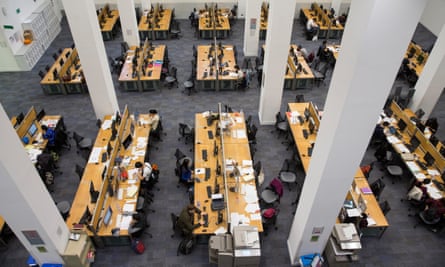
main library at the London School of Economics. ‘Stem is flourishing,
but it is a cause for concern that other subjects on the tree of
knowledge are in less good shape.’ Photograph: Andrew Aitchison/In Pictures via Getty Images
The
acronym Stem – science, technology, engineering and mathematics – was
coined in the US in 2001. The idea of integrating and promoting skills
seen as key to turbo-charging American prosperity had been around for a
while, but as Smet, which is far less catchy. Stem quickly took root and
spread beyond the US, not least because of its power as a metaphor: it
makes the subjects sound foundational, central, while everything else is
edging. In a climate of rickety job prospects, high tuition fees and a
correlation of degrees with starting salaries, Stem subjects are equated
with employability, good incomes and stability. Nicky Morgan was not
unusual when, as the education secretary, she said: “[In the past] if
you didn’t know what you wanted to do … the arts and humanities were
what you chose because they were useful … We now know this couldn’t be
further from the truth. The subjects to keep young people’s options open
are Stem subjects.”
Last year, the number of
British students taking the three types of English A-levels dropped by
20% compared with two years before, while those studying performing and
expressive arts fell by 53%. Over the decade to 2017, the numbers studying languages at British universities fell by 35%, while the figure for those studying biology, maths and medicine rose (by 47%, 26% and 11% respectively).
Stem
is flourishing, but it is a cause for concern that other subjects on
the tree of knowledge are in less good shape. Falling numbers of English
graduates will soon coincide with a baby bulge just hitting secondary
schools, which over the next decade will need 50,000 more teachers,
especially in core subjects; the Black Lives Matter protests underscored our thoroughgoing incomprehension of our history.
But
besides such practical issues is the larger question of what a good
life is. This week, a group spearheaded by the British Academy and
including the London School of Economics and Arts Council England
offered their answer: a parallel acronym, Shape – social sciences,
humanities and the arts for people and the economy. So everything from
fine art to psychology to economics: the disciplines that help us govern
ourselves, understand how we have developed over time and argue for
doing it all better.
The argument for Shape can, if necessary, be economic: last year the arts and culture sector overtook agriculture
in terms of its contribution, at £10.8bn a year. The humanities’
supposed lack of obvious vocational pathways is in fact a strength in an
economy where flexibility and entrepreneurship are prized, while the
perception of lower employability is not borne out by facts – 88% of Shape graduates were employed in 2017 (compared with 89% for Stem).
Shape
subjects will also be central to answering the most urgent questions we
face; science, for instance, is foundational to comprehending the
climate emergency, but will not effect the political and behavioural
changes needed to achieve net zero. Nor will it necessarily predict or
mould the future. Eric Hobsbawm may have found it baffling that
“brilliant fashion designers … sometimes succeed in anticipating the
shape of things to come better than professional predictors”; the fact
remains they sometimes can. The stem of a plant is, after all, sustained
and not just decorated by its leaves.
We
should not be shy to argue for confidence and curiosity, joy and
openness as good in themselves. Along with Stem, Shape subjects have the
potential to open up the full extent of our humanity, to help shape a
well-rounded, empathetic and resilient body politic. Fighting for equal
weighting for these disciplines is not only good but also necessary.
•
This article was amended on 29 June 2020 to remove an incorrect
reference to Nicky Morgan having been the UK’s education secretary. As
education is a devolved matter, Morgan oversaw education policy for
England only.
A “partial reopening” of the tourism sector in Wales is to take place over the next few weeks as long as rates of coronavirus continue to fall, the Welsh government has announced.
The Labour-led government has asked visitors to enjoy their time in the country – but to respect local communities.
Bars, restaurants and cafes with outdoor spaces are set to be allowed to re-open from 13 July.
The final decision about outdoor re-opening will be made at the next Welsh government review on 9 July.
Future decisions about indoor re-opening will be made later and depend on the success of outdoor opening.
The “stay-local” instruction in Wales is due to lifted on Monday, which will allow outdoor attractions to re-open from then.
The date from which owners of self-contained accommodation in Wales
can accept bookings is being brought forward to 11 July from 13 July, to
help with the pattern of Saturday-to-Saturday bookings.
The minister for international relations and the Welsh language, Eluned Morgan, said:
Tourism is a vital part of the Welsh economy at a national, regional
and local level. I’d like to thank all our industry partners for working
with us to carefully reopen the visitor economy.
A successful, safe and phased return will give businesses,
communities and visitors confidence to continue with the recovery of the
visitor economy.
We ask everyone who travels to and around Wales to enjoy their time
here, but always to respect local communities. We are looking forward to
welcoming visitors back to Wales – but we want everyone to visit Wales
safely.
Morgan defended the government’s cautious approach to bars, cafes and restaurants re-opening.
She said: “If we open too quickly we will have to go back into
lockdown. That is why we are taking this step-by-step controlled
approach.”
The two-metre social distancing in Wales will remain for pubs but
Morgan said the government was working with the industry on additional
measures for circumstances when the two-metre rule could not work.
Additional measures may include a designated person being in charge
of making sure premises were Covid-19 safe and taking names of customers
so they could be traced if needed.
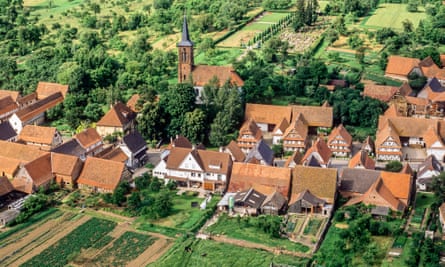
At least half the Hunspachois,
as they are known, turned out in the centre of the village to celebrate
the result, relayed via a giant screen on Wednesday evening.
Viewers
said they had chosen Hunspach for its picturesque black and white
half-timbered houses – similar to British Tudor architecture. Many of
them have baroque-era convex glass windows, allowing inhabitants to see
out without being seen.
Guide books describe
Hunspach, also a stop on the Haguenau to Wissembourg railway, as
“peaceful”, but it is unlikely to remain so for long. In 2014,
Eguisheim, also in Alsace, was voted favourite village and promptly
attracted hundreds of thousands tourists.
Hunspach
is situated in north-east Alsace near the German border, in the
northern part of the Vosges nature park, near the Fort de Schoenenbourg,
one of the largest structures of the Maginot Line.
The
village was first mentioned in a document in 1298. During the
Reformation it became a Protestant village and in 1619 came under
Swedish administration. After being attacked and destroyed by imperial
troops in 1633 it was repopulated by immigrants from Switzerland. In
1797, Sweden handed the village back to the French crown.
The
entire Alsace region was annexed to the new German empire in 1871 after
France’s defeat in the Franco-Prussian war. But in 1918, after
Germany’s defeat in the first world war, Alsace was handed back to
France under the treaty of Versailles. The region was occupied by
Germany again during the second world war when inhabitants were ordered
to become German citizens under Nazi decree.
Until
now, Hunspach was best known for its annual Fête du Folklore, held
during the last weekend in spring. The annual France’s Favourite Village
competition is a showcase for little-known communes in France to
encourage tourism.
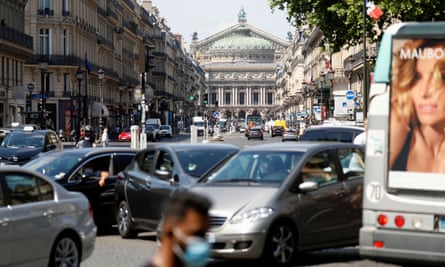
The
French are the road-rage champions of Europe, according to a survey,
with the highest number of drivers who feel they become more aggressive
when they get on the road.
The 10th annual poll
of “responsible driving” published by the Vinci Motorway Foundation and
carried out by the Ipsos polling agency in 11 European countries,
revealed that one French driver in five – and more in the Paris area –
has a Jekyll and Hyde personality behind the wheel.
They
admitted they were “no longer really the same person when driving and
are more agitated, impulsive or aggressive than in normal life”.
One
out of 10 French drivers believes it is “every person for themselves”
on the roads, according to the survey, which can emerge as bad behaviour
towards other drivers who have upset them, including insults and
swearing.
French drivers shared joint first
place with Greeks in the self-reported poll as the most likely to hurl
insults at fellow road-users – 70% of all those surveyed.
“The
tendency of drivers to feel in their own bubble when they are in their
vehicle makes them forget the collective nature of driving and as a
result their behaviour towards others,” said Bernadette Moreau of Vinci.
“The
vast majority of French are extremely indulgent towards their own
driving, but much less so with that of others,” she added, saying the
findings showed drivers described their own behaviour behind the wheel
as “calm and courteous” but others as “irresponsible and dangerous”.
The
survey revealed that 78% of European motorists admitted they had taken
their eyes off the road to look at their phone or the radio while
driving, almost none respect a safe distance between vehicles, and a
third will deliberately drive close to another vehicle whose driver has
annoyed them.
The Swedes were mostly likely to
drive too fast and the Spanish the keenest to use their horns. The
Greeks topped the list for dangerous road behaviour and the British
last.
At least half the Hunspachois,
as they are known, turned out in the centre of the village to celebrate
the result, relayed via a giant screen on Wednesday evening.
Viewers
said they had chosen Hunspach for its picturesque black and white
half-timbered houses – similar to British Tudor architecture. Many of
them have baroque-era convex glass windows, allowing inhabitants to see
out without being seen.
Guide books describe
Hunspach, also a stop on the Haguenau to Wissembourg railway, as
“peaceful”, but it is unlikely to remain so for long. In 2014,
Eguisheim, also in Alsace, was voted favourite village and promptly
attracted hundreds of thousands tourists.
Hunspach
is situated in north-east Alsace near the German border, in the
northern part of the Vosges nature park, near the Fort de Schoenenbourg,
one of the largest structures of the Maginot Line.
The
village was first mentioned in a document in 1298. During the
Reformation it became a Protestant village and in 1619 came under
Swedish administration. After being attacked and destroyed by imperial
troops in 1633 it was repopulated by immigrants from Switzerland. In
1797, Sweden handed the village back to the French crown.
The
entire Alsace region was annexed to the new German empire in 1871 after
France’s defeat in the Franco-Prussian war. But in 1918, after
Germany’s defeat in the first world war, Alsace was handed back to
France under the treaty of Versailles. The region was occupied by
Germany again during the second world war when inhabitants were ordered
to become German citizens under Nazi decree.
Until
now, Hunspach was best known for its annual Fête du Folklore, held
during the last weekend in spring. The annual France’s Favourite Village
competition is a showcase for little-known communes in France to
encourage tourism.
The most important blockbuster art show in Paris for half a century
took 10 years to prepare and was nearly thwarted by the worst diplomatic
standoff between Italy and France since the second world war. With days
to go before the opening, there is still no sign of whether one of the major works will appear.
The Louvre’s vast Leonardo da Vinci exhibition
to mark 500 years since the death of the Italian Renaissance master
will finally open next week as the world’s most-visited museum prepares
to handle a huge influx of visitors.
One of the
most expensive exhibitions ever staged in France, it is the first time
that such a large number of Leonardo’s drawings, sketches, writings and
paintings have ever been brought together.
But a question mark still hangs over whether Salvator Mundi
— the world’s most expensive painting — will be loaned. Mystery
surrounds who owns the painting, a depiction of Jesus in Renaissance
dress, which was once thought to be held in the Gulf. Unusually, the
exhibition space has been designed to accommodate pictures arriving or
being refused at the last minute. “We’ve never been in this situation
before,” a museum representative said.
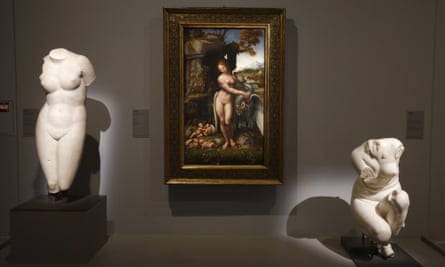
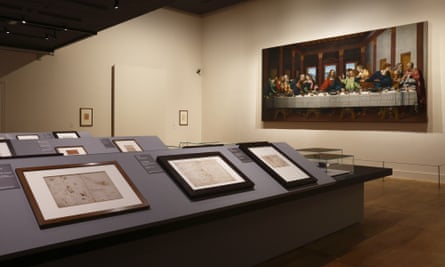
Leonardo da Vinci exhibition at the Louvre. Photograph: Antoine Mongodin
Leonardo,
whose life has been a constant source of myth-making, is considered a
visionary genius – a painter, scientist, engineer and inventor. Born the
illegitimate son of a notary in the Tuscan hill town of Vinci in 1452,
the Italian humanist worked in Florence and Milan,
and spent his final years at the court of the French king Francis I in
the Loire, where he died on 2 May 1519. Since then what is known on his
life has been pored over and seized upon; his vegetarianism and interest
in animal welfare have been cited by French anti-hunting groups while
the androgynous faces in many of his portraits are considered by some as
a modern questioning of gender.
At
the heart of the Louvre’s exhibition are the lessons that can be
learned about Leonardo’s personality from the awe-inspiring realism in
his work: portraits such as La Belle Ferronnière, the Mona Lisa or his
depiction of Saint John the Baptist.
Leonardo
painted relatively little – there are only about 15 remaining paintings –
of which nine are in this show. He worked painstakingly slowly, often
spending more than a decade on a painting. The exhibition includes many
of his outstanding drawings. The curators argue that his interest in
science – particularly astronomy, botany and his constant grappling with
mathematical problems – was not a digression that pulled him away from
art, but was central to his quest to achieve perfection in his painting.
“He
had an ability not just to depict things from the outside, but to also
show what was inside: the movement and vibration of life, the inner
emotions,” said Louis Frank, one of the show’s curators.
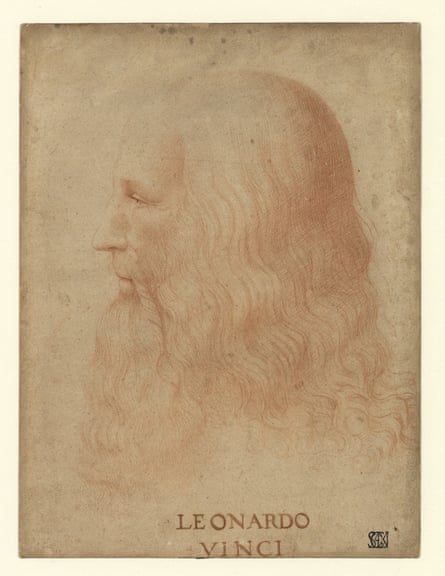
Portrait of Leonardo da Vinci. Photograph: Gianni Cigolini/Mondadori Portfolio/Veneranda Biblioteca Ambrosiana
Yet the Mona Lisa
– one of the main attractions for the Louvre’s 30,000 visitors a day –
will remain upstairs in its usual permanent hanging place. The temporary
exhibition space devoted to the Leonardo show can only accommodate
7,000 people per day and the museum did not want to prevent other
visitors seeing it. There will also be a virtual reality experience of
the Mona Lisa for the first time. As the Louvre faces ever higher
visitor numbers, the Leonardo exhibition will only be open to people who
have pre-booked.
The whole exhibition was in danger last year when Leonardo was dragged into a long-running political spat
between Italy’s then far-right ruling League party and France’s
president, Emmanuel Macron. Italy said it would cancel the loan of some
paintings, accusing France of trying to take centre stage in the
commemorations marking 500 years since the painter’s death. “Leonardo is
Italian; he only died in France,” one far-right MP said.
The row was finally resolved but then a last-minute legal challenge this month nearly stopped da Vinci’s Vitruvian Man –
a study in anatomical proportions – from appearing. An Italian heritage
group said the drawing, which is kept in a climate-controlled vault at
the Accademia Gallery of Venice, was too fragile to travel
and risked being damaged by lighting in the Louvre if displayed for a
long period. A court ruled the work could travel. It is currently in
transit, and will arrive next week to be shown for a limited period.
Vincent
Delieuvin, one of the show’s curators, said the exhibition would
explain how Leonardo established that the secret to creating perfect
paintings that laid bare human nature was to capture light, shade and
movement. For Leonardo, it was about opening one’s mind to “an absolute