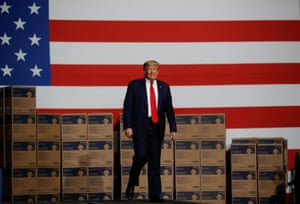
Donald Trump visits a medical equipment distributor during his visit to Allentown, Pennsylvania.
Photograph: Carlos Barría/Reuters
Few
people understand the terrible cost of the coronavirus like Lee Snover,
a Republican party chair in one of the key swing counties that could
determine whether Donald Trump is re-elected as president in November.
Snover, who helped deliver an upset victory for Trump in 2016 in
Northampton county, Pennsylvania, lost her father to the virus this
spring. Her husband fell critically ill, too, spending 17 days in an
intensive care unit before recovering. Her mother, a cancer survivor,
was also in intensive care for eight days before emerging.
“It spread through my entire family,” Snover said.
Trump stands accused of driving up the coronavirus death toll by
downplaying the public health threat and urging the country to “reopen”
too quickly. But Snover does not see the president as having failed her
family.
“I don’t think people give him enough credit,” she said. “If
you think about what a businessman he was, and how much he loved that
booming economy, do you know how hard it was for him to shut the country
down? That was hard. So I give him credit for that.”
At times it has appeared that the pandemic, which has already taken
at least 90,000 lives in the United States and wreaked havoc with the
economy, would also destroy support for Trump, and his chances for
reelection. But interviews with longtime Trump supporters in Northampton
county indicate the extraordinary durability of backing for the
president among his base.
The state that decides Trump’s win
As part of his nascent return to the campaign trail during the
pandemic, Trump made a trip to Snover’s backyard, in Allentown,
Pennsylvania, last week. He visited a medical equipment distributor and
blasted Governor Tom Wolf, a Democrat, for not easing virus mitigation
measures sooner.
“Next year is going to be through the roof,” Trump said. “We have to
get your governor of Pennsylvania to start opening up a little bit. You
have areas of Pennsylvania that are barely affected, and they have –
they want to keep them closed. Can’t do that.”
Supporters gather to welcome Donald Trump’s motorcade in Allentown, Pennsylvania. Photograph: Matt Smith/REX/Shutterstock
It was only Trump’s second outing since the pandemic hit, and the
venue was carefully chosen. Northampton, which borders Allentown and is
the subject of an ongoing Guardian series,
was one of only three counties statewide to vote twice for Barack Obama
before falling for Trump in 2016; handing him the massive electoral
prize of Pennsylvania – and the presidency.
If Trump can win here again, political analysts say, he has a good chance of holding the White House.
Christopher Borick, director of the Institute of Public Opinion at
Muhlenberg College in Allentown, said that the pandemic does not appear
to have changed the race for Trump much in the Lehigh Valley.
“Despite this enormous thing happening, I don’t see clear indicators
that the race itself has changed here, in the sense that there’s been
only some modest movement in polls” in recent months, Borick said.
“While the world has changed since the onset of the pandemic, the
political calculus hasn’t.”
‘We’re lucky to get a president like him’
Joe D’Ambrosio, 79, who has cut hair in Bethlehem, Pennsylvania, for
more than 50 years, was also struck by tragedy this spring, when one of
his best friends died from the virus.
“He and his wife caught a cold,” D’Ambrosio said. “He was perfectly
healthy, this was six weeks ago. She caught a cold, he caught a cold, so
he said to his wife, ‘I just can’t breathe right’. So they go to the
hospital.”
His friend fought for a week. “When you talk about two people from
Minnesota that died from it, they’re just statistics,” D’Ambrosio said.
“But when they’re close to you, then you realize how real this thing
is.”
Like a lot of older Democrats in a town that was once home to the
legendary – and heavily unionized – Bethlehem Steel, D’Ambrosio voted
for both parties over the years before coming out as an early and
enthusiastic Trump supporter. That support has not changed.
“I’ll tell you what, I think we’re so lucky that at this time in our
life, we were able to get a president like him, at the right time,”
D’Ambrosio said.
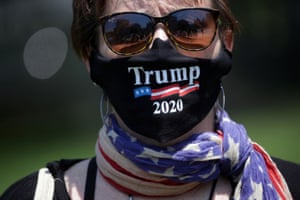
A protester wears a Trump face mask while rallying
against the coronavirus restrictions in Pennsylvania. Photograph:
Jonathan Ernst/Reuters
He dismissed criticism that Trump had made the country complacent by advising that the virus would “disappear”.
“What he did was damage control,” D’Ambrosio said. “People were
starting to panic, buying everything, emptying the stores. He got it to
calm down.”
Pennsylvania has recorded more than 4,000 Covid-19 deaths, mostly in
the Philadelphia metropolitan area. Last week Wolf announced an
additional $16m in funding for food banks, where people have queued up before dawn, after the state shed about 2m jobs from mid-March onwards.
Bruce Haines, a former steel executive who runs the Historic Hotel
Bethlehem, a crown jewel of the local tourism industry, said business
had plunged.
“It was like you turned off a lightbulb,” Haines said on the phone
from Florida. “The cancellation calls the week of 9 March were
incredible. And it hit us blindly, because we were coming off our best
year ever in 2019.”
Haines praised Trump’s move to reopen the economy. “I think it’s
right on target, and it’s necessary,” Haines said. “And anybody who’s a
businessman knows that Trump’s the right guy there, to bring us out of
this downturn. Because he’s a businessman.”
A downward trend
Peg Ferraro, a Republican official popular with Democrats who for
years was the only woman on the county council, retired last year and
also spoke on the phone from Florida.
“I think he’s doing as well as could be expected under the
circumstances, where you’ve never been through it really before,” she
said of Trump. “I think he was absolutely correct in leaving it up to
the governors – they know their states better than making blanket
statements for everybody.”
Trump’s visit to Pennsylvania last Thursday represented a headache
for Wolf, who is in an escalating war with Republican officials over
reopening the state county by county. True to a national pattern,
Republicans from more rural districts in the state are less likely to
see the pandemic as dangerous than Democrats, Borick said.
Trump supporters hold signs highlighting their
displeasure with Pennsylvania’s governor. Photograph: Matt
Rourke/Associated Press
Trump could still lose in the Lehigh Valley. Public approval of his
handling of the coronavirus crisis has plunged nationally from about 50%
in late March to just over 40% now, with about 55% disapproving, according to polling averages. While there is plenty of time before the election to reverse that slide, polling in Pennsylvania shows a similar trend.
Trump’s margin of victory in 2016 in Northampton county was narrow,
spurred by record turnout. And his opponent in that race, Hillary
Clinton, was disliked by voters in a way that Joe Biden, the presumed
Democratic nominee, who grew up in Pennsylvania, does not appear to be.
The unique logistics of the fall election could also go a long way in
deciding the victor here, Borick said. Just last year, Pennsylvania for
the first time approved absentee voting for everyone, potentially
throwing the advantage in November to the party that shows better
organization at standing up vote-by-mail and at getting people to the
polls amid a potential second pandemic wave.
And for all the president’s support in the region, there is a resistance to Trump that is as galvanized as his base.
“He couldn’t run a one-car funeral,” said Frank Behum, a former unionized steelworker and vocal Trump critic.
“Even my Republican friends, they’re telling me they’re not voting
for that clown again. But you don’t know – remember in the 1980s, people
said they’re not voting for Reagan either.
“So you don’t know what they’re going to do.”





No comments:
Post a Comment