Biggest ever Leonardo da Vinci exhibition to open in Paris
Louvre will host works of Italian artist after long-running political spats and legal battles

Angelique Chrisafis in Paris
Published on Sat 19 Oct 2019 05.00 BST
The most important blockbuster art show in Paris for half a century
took 10 years to prepare and was nearly thwarted by the worst diplomatic
standoff between Italy and France since the second world war. With days
to go before the opening, there is still no sign of whether one of the major works will appear.
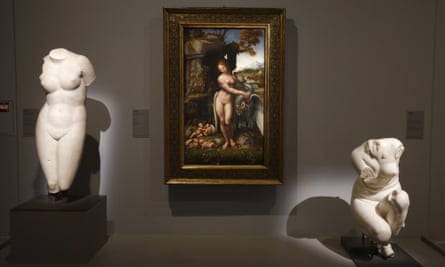
The Louvre’s vast Leonardo da Vinci exhibition
to mark 500 years since the death of the Italian Renaissance master
will finally open next week as the world’s most-visited museum prepares
to handle a huge influx of visitors.
One of the
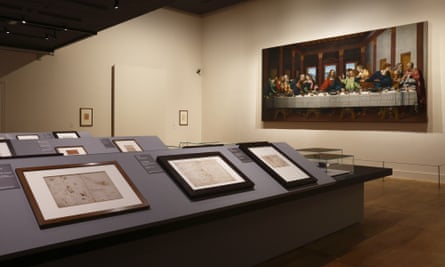
most expensive exhibitions ever staged in France, it is the first time
that such a large number of Leonardo’s drawings, sketches, writings and
paintings have ever been brought together.
But a question mark still hangs over whether Salvator Mundi
— the world’s most expensive painting — will be loaned. Mystery
surrounds who owns the painting, a depiction of Jesus in Renaissance
dress, which was once thought to be held in the Gulf. Unusually, the
exhibition space has been designed to accommodate pictures arriving or
being refused at the last minute. “We’ve never been in this situation
before,” a museum representative said.
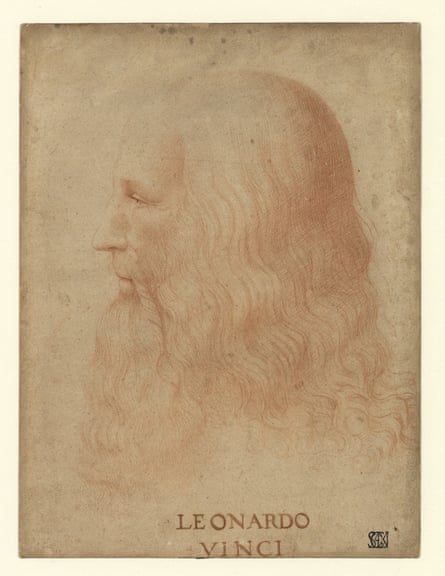
Leonardo,
whose life has been a constant source of myth-making, is considered a
visionary genius – a painter, scientist, engineer and inventor. Born the
illegitimate son of a notary in the Tuscan hill town of Vinci in 1452,
the Italian humanist worked in Florence and Milan,
and spent his final years at the court of the French king Francis I in
the Loire, where he died on 2 May 1519. Since then what is known on his
life has been pored over and seized upon; his vegetarianism and interest
in animal welfare have been cited by French anti-hunting groups while
the androgynous faces in many of his portraits are considered by some as
a modern questioning of gender.
At
the heart of the Louvre’s exhibition are the lessons that can be
learned about Leonardo’s personality from the awe-inspiring realism in
his work: portraits such as La Belle Ferronnière, the Mona Lisa or his
depiction of Saint John the Baptist.
Leonardo
painted relatively little – there are only about 15 remaining paintings –
of which nine are in this show. He worked painstakingly slowly, often
spending more than a decade on a painting. The exhibition includes many
of his outstanding drawings. The curators argue that his interest in
science – particularly astronomy, botany and his constant grappling with
mathematical problems – was not a digression that pulled him away from
art, but was central to his quest to achieve perfection in his painting.
“He
had an ability not just to depict things from the outside, but to also
show what was inside: the movement and vibration of life, the inner
emotions,” said Louis Frank, one of the show’s curators.
Yet the Mona Lisa
– one of the main attractions for the Louvre’s 30,000 visitors a day –
will remain upstairs in its usual permanent hanging place. The temporary
exhibition space devoted to the Leonardo show can only accommodate
7,000 people per day and the museum did not want to prevent other
visitors seeing it. There will also be a virtual reality experience of
the Mona Lisa for the first time. As the Louvre faces ever higher
visitor numbers, the Leonardo exhibition will only be open to people who
have pre-booked.
The whole exhibition was in danger last year when Leonardo was dragged into a long-running political spat
between Italy’s then far-right ruling League party and France’s
president, Emmanuel Macron. Italy said it would cancel the loan of some
paintings, accusing France of trying to take centre stage in the
commemorations marking 500 years since the painter’s death. “Leonardo is
Italian; he only died in France,” one far-right MP said.
The row was finally resolved but then a last-minute legal challenge this month nearly stopped da Vinci’s Vitruvian Man –
a study in anatomical proportions – from appearing. An Italian heritage
group said the drawing, which is kept in a climate-controlled vault at
the Accademia Gallery of Venice, was too fragile to travel
and risked being damaged by lighting in the Louvre if displayed for a
long period. A court ruled the work could travel. It is currently in
transit, and will arrive next week to be shown for a limited period.
Vincent
Delieuvin, one of the show’s curators, said the exhibition would
explain how Leonardo established that the secret to creating perfect
paintings that laid bare human nature was to capture light, shade and
movement. For Leonardo, it was about opening one’s mind to “an absolute

No comments:
Post a Comment